On January 20, 2009 at the same moment that Barack Obama was becoming President of the United States a team of folks was quietly moving into the White House and relaunching the White House's website and now 4 months later the site is quickly becoming one of the best social studies teaching websites on the web.
The site which includes all the usual bells and whistles of a White House website (i.e. presidential history, press room, calendar, photo tours, and biographies) also now has the latest and greatest in Web 2.0 technology. It is important to note and a great learning activity to think about how the President can use the web. Of course President Obama is not the first president to have a website, that honor belongs to President Clinton who launched the first White House website in 1994. Like all good government docuemnts it is not in the National Archives and you can still visit the site via the archives. Take a look with your students, and marvel and the 15 year old web technology.
Just like President Clinton, who was breaking new ground by just having a website President Obama is using web as a tool of government. On the White House website you can:
- Read the White House Blog
- Watch live events or archived video
- Particpate in new Open Government Programs
- Follow the White House on Twitter
Tuesday, May 26, 2009

Thursday, May 21, 2009
School Lunch-Yum or Yuck
Just came across a great new blog about School Lunch policy (this is the lunch lady you know and love). School Lunch Talk is a fascinating looking into the politics and science of school lunch. I found the blog via Mark Bittman at the NY Times, he was writing about the recent SLT blog post on eating school lunch in Italy.
School lunch and cafeteria issues have always been a great idea for service learning projects. I remember hearing a teacher in Columbus, Ohio tell me about the great project that she had run with her students doing a profit/loss analysis of eating in the school cafeteria vs. allowing students to leave school and eat in the community. This posting on school lunches in Italy, sparked a new idea: Ask students to examine eating habits and school lunches in countries around the world. A very middle school project, but could be a fascinating way to have students interact with peers around the world and examine cultures other than their own.
School lunch and cafeteria issues have always been a great idea for service learning projects. I remember hearing a teacher in Columbus, Ohio tell me about the great project that she had run with her students doing a profit/loss analysis of eating in the school cafeteria vs. allowing students to leave school and eat in the community. This posting on school lunches in Italy, sparked a new idea: Ask students to examine eating habits and school lunches in countries around the world. A very middle school project, but could be a fascinating way to have students interact with peers around the world and examine cultures other than their own.
Teach Art History with LEGO
 I have always been a big fan of teaching art history in the social studies classroom. Works of art and architecture do more than add some nice visuals to a lesson they can serve as a primary source for historic time-periods or more importantly diversify your lesson to reach all of your students learning styles.
Keeping these in mind I was excited to see a new line of LEGO, the Architecture series construction sets. These sets provide blocks and instructions to build some of the greatest examples of modern architecture. Above you can see Frank Lloyd Wright's masterpiece, Fallingwater. Using this building you can teach your students concept of modern design and have them pose questions about why building aesthetics like these were popular in the time period when it was constructed. This high level conversation can happen, while you Kinesthetic learners are plugging away at the LEGO blocks puttin together the building.
Check out all the buildings in the LEGO Architecture series at: http://www.brickstructures.com/0ConstructionSets.html
Wednesday, May 20, 2009
A dollar by any other name...
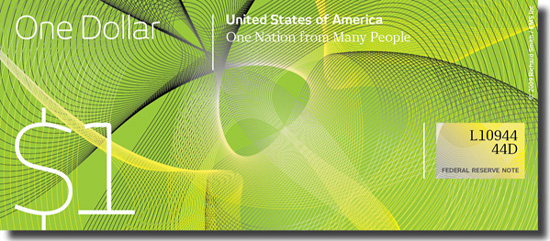 Think back a couple of months ago, President Obama and his team were just getting started they were making plans and trying wrap their minds around how best to address the difficult economic situation the nation now faces. If you listened carefully and beyond the media sound bite you heard a sense of opportunity for that word we heard again and again on the campaign trail, change.
Now over four months later change has started to come: expansion of TARP, stimulus money, new regulation of credit card markets, fuel standards, and many more. But, what about other aspects of the economy like money itself. Design strategist Richard Smith has posted a challenge on his blog "We need to rebuild our country, revive our economy, redesign the Dollar bill. Email us your ideas. Win a prize. In God We Trust, In Change We Believe."
Posted above is just one example of a number of submissions. This is a great activity (especially for the end of the year) for students. Pose the question:
- Does the design of our money represent us?
- How can changing the design of paper money help the economy?
- What do you think US currency should look like?
Friday, May 15, 2009
A Diploma In Latin

There is a great op-ed in the NYT today about colleges and universities printing diplomas in Latin. I do not have one of the these, the University of Delaware and NYU are plain English folks. I have always found diplomas completely written in Latin to be a bit ridiculous. The example I always give is Kim's masters diploma from Penn, she is a graduate of the prestigious Annenberg School of Communication and the diploma, written entirely in Latin, has the school names as ANNENBERGIUM. Come on folks, this a person's name here.
Don't let this post fool you, I am huge fan of pomp and circumstance especially around academic events. I am sitting in my office right now looking at my academic regalia hanging on the back of my door ready to go for Sunday's commencement exercises here at LPS. But in the end, I completely agree with the author---Latin diplomas unnecessary!
Sunday, January 11, 2009
25 Inaugural Addresses
HotChalk a great new educational online video provider has posted video of 25 Inaugural addresses. Not everyone is really a video of the inauguration they start with President Washington (and even your middle schooler will tell you that there was no TV in 1789!). Videos include silent film from the early 1900s and the most recent presidents. As we count down the days until the Inauguration on January 20, this is a great resource to share with your students. If you have the technology: divide the students up and assign each student an inauguration to present to the class---a little jigsaw action? or better yet show 2 or 3 a day leading up to Jan. 20 and then on the 21st add President Obama and vote on the best one!
Monday, December 8, 2008
Teaching with your head in a Word Cloud
Over the summer, I head about the Wordle website and became fascinated with the classroom application of it. I shared it with teachers at some of our summer teacher institutes and they also loved it. Recently, it has come back to my attention (we were discussing tag clouds, believe it or not). Now I wanted to to share it with you. The site is amazing, think about it---you have students write an essay and then have them feed it into the site and out pops not just a very cool piece of graphic design but also a great analysis of their writing style. You can have them analyze words they choose to use (and use to often) and you get an instant bulletin board item.
Check out my creation using the text of the Untied States Constitution!

Check out my creation using the text of the Untied States Constitution!
Sunday, December 7, 2008
Visiting MO and teaching from Philadelphia!
On Friday, I worked with friend Eric Langhorst's class in Liberty, MO for my first virtual field trip. Using the new gChat video-conference I spent about 20 minutes taking his 8th graders on a tour of Signers Hall at the Constitution Center. I have to say from my end it was amazing, a real time conversation where I saw and heard the students perfectly. We had a great back in forth conversation, I posed questions, they answered and when a hand went up I had no problem seeing it and calling on the student. Love this technology, and I cannot wait to take it to scale. You can see more photos and video over at Eric's great blog Speaking of History.
Subscribe to:
Posts (Atom)
